Published as “Father Knows Best: The State of State Beer Laws” in All About Beer, January 1998. The laws may have changed, but here’s how they stood many years ago.
***
Beer drinkers never travel alone. They are always accompanied by the wide-eyed spirit of discovery or the grim specter of frustration. It’s the law. Each of the 50 U.S. states has them, and they vary widely.
In Mississippi, you can’t visit a brewpub, because they don’t allow them. Ditto Montana, except a restaurant can operate a brewery next door and serve the beer to its customers. Would-be brewers can open a brewpub in Alabama, if they build it in an historic building, if they are not in one of Alabama’s dry counties, and if their wet county passes a special law allowing draft beer – which is a lot of if’s.
In Massachusetts, a retailer who wants to promote his selection of wines can hold a wine tasting in his store, but a retailer who wants to promote his beer selection cannot hold a beer tasting. In Connecticut, you can go to any winery, take a tour, and buy wine to take home. But you cannot go to a brewery, take a tour, and buy beer to take home.
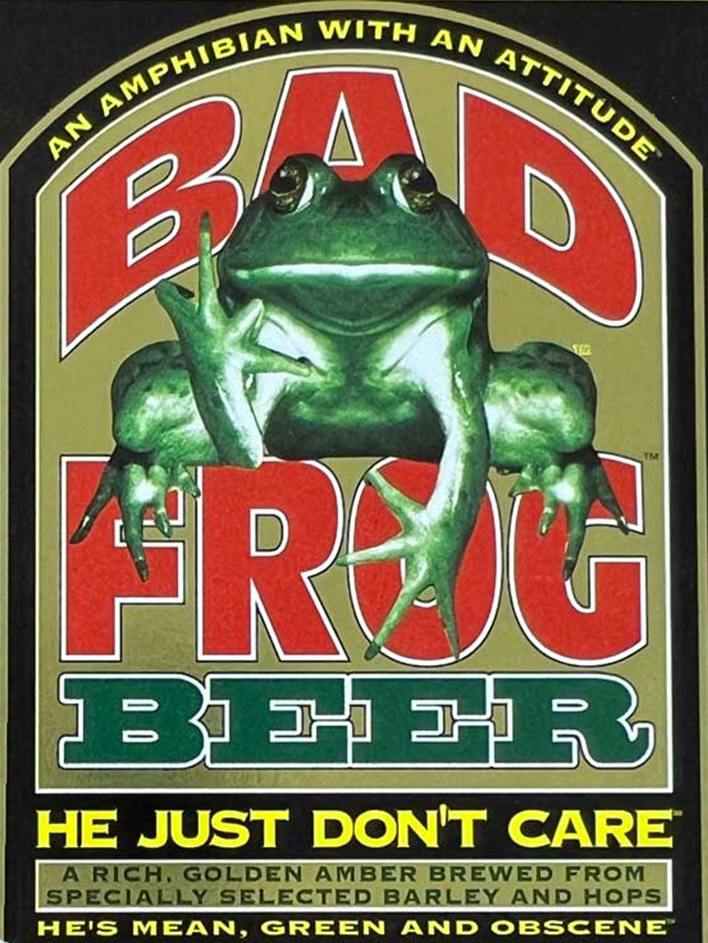
In Pennsylvania, you can only buy beer by the case at a State Store. Individual beers or six-packs can be purchased in bars, but at a hefty premium. You can buy beer any way at all in New York, except you won’t find any Bad Frog Beer with its rude amphibian label because, as the State Liquor Authority puts it, “Within the state of New York, the gesture of ‘giving the finger’ to someone is a confrontational, obscene gesture known to lead to fights, shootings and homicides.”
Until recent legislation, Vermonters couldn’t have two open beers on the bar at the same time. Nor could New Mexico brewpubs serve beer on Sunday, although they could sell wine. And a server in a Utah brewpub could not approach patrons to ask if they wanted beer; the patrons had to ask for it.
Where do these laws come from? Beer correspondent Stan Hieronymus notes, “Some are grandfathered in from Prohibition; some are in place for perceived tax revenue, and others are simply anticompetitive regulations that favor a select few.”
Essentially, existing brewers, distributors, retailers and restauranteurs don’t want competition. So retailers and restauranteurs lobby against brewpubs. Breweries and distributors lobby against brewpubs and imports, even imports from other states. Mothers Against Drunk Driving (MADD) lobbies against any and all legislation that could be construed as favorable to the increased dissemination of beer.
And when the laws are being made, state legislators vote as they are directed, unless the collective gaze of press and public forces them to do otherwise. Then they compromise, trying to please all their constituents, and the resulting laws often seem somewhat less than rational.
The first class of laws that limit choice are those that limit alcohol content. Alabama, Arkansas, Mississippi, North Carolina, Ohio, South Dakota and Tennessee all place limits on beers’ alcohol content, generally in the 5% to 6% range. The theory put forth for the public good is that with less alcohol in the beer, the drinker will consume less alcohol, hence behave in a more roadworthy and civilized manner. Without going into the efficacy of such legislation, it’s a difficult law to change or repeal without the legislator appearing to be in favor of broken homes, ruined lives and carnage on the highway.
The effect of such laws on the beer drinker, whether a resident or someone just passing through, is to capitate the beer styles of the world. If you are in search of an American light lager with an industrial pedigree, no problem: it’s less than 4% by weight. But if you are in the mood for an Oktoberfest, Marzenbier or Christmas beer, any true bock beer, an India Pale Ale, a Belgian ale, then you are often over 5% or even 6%. You will not find these beer styles in these states, unless they are modified versions or smuggled in from a more liberal clime.
Move up to Sam Adams Triple Bock, and you step into a regulatory quagmire. At 17.5% by volume, it’s banned outright in many states. But into West Virginia, it runs into a unique Catch-22. One law decrees that, because of its alcohol content, Sam Adams Triple Bock must be stored in a “state warehouse.” But another law says that malt products cannot be stored in a “state warehouse.”
Perversely, a beer can be penalized for being too low in alcohol. Texas insists that anything below 4% alcohol by weight is beer, and anything over 4% is either ale, malt liquor, porter or stout – regardless of the manner of fermentation or beer style. Hence Sam Smith’s Oatmeal Stout and Sam Adams Cream Stout, both under 4% by weight, are not “stout” in the eyes of Texas but “beer.” And therefore must be renamed “Oatmeal Beer” or “Cream Beer,” or reformulated to a higher strength. Neither Sam is enthusiastic about these options.
Another wrinkle in Texas beer laws has the effect of banning Anchor Steam beer on draft. It’s a “beer” and comes in European-style 50-liter keg. In Texas, draft beer can only be sold in a keg that is 31 U.S. gallons (in effect, keeping out all European draft beers). But the Texas law has a loophole: “ale” and its more alcoholic brethren can come in any size container at all. Thus Anchor’s stronger products – Liberty Ale, Porter and Old Foghorn Barleywine – can be sold on draft.
Texas also limits the allowable sizes of beer bottles, again to keep out imports. For many years, the only legal sizes were 12, 16, 24 and 32 ounces. But in the early 1970s, the major brewers spent three years and lots of money and succeeded in adding 7- and 8-ounce containers to the list.
Texas, however, is wide open when compared to Florida, home of the seemingly invincible Statute 563.06, which decrees that beer can only be sold in containers holding exactly 8, 12, 16 or 32 ounces. This eliminates all beers that come in metric sizes, e.g., Belgian ales, German wheat beers and domestic craft beers like the aforementioned Sam Adams Triple Bock, which comes in an 8.6-ounce bottle.
For public consumption, the statute’s supporters maintain that chaos would follow a repeal of the law. Beer trucks couldn’t efficiently carry the odd shaped brews. Stores couldn’t efficiently store shelves or coolers. And into this jumble would wander the unwitting masses of Florida to be baffled and cheated by metric sizing. Ken Detzner, executive director of the Beer Wholesalers Association of Florida, boldly said, “Our law protects the consumer. When consumers buy a 12-ounce container, they’re getting 12 ounces of product.”
Cynics, however, note that Florida’s law wasn’t put into place to protect the people from metrics, rather to punish Miller Brewing for building a brewery across the border in Georgia in 1965. Miller, which has a 7-ounce bottle they cannot use in Florida, got a spanking, and Anheuser-Busch, which did build a plant in Florida, got a gift-wrapped anticompetitive law. And they are paying to keep it strong against all comers.
“No one is more giving in campaign contributions than Budweiser and Anheuser-Busch,” said Rep. Ed Healey, D-West Palm Beach, who received nearly $4,000 from the alcoholic beverage industry when he last ran for reelection. Healy said he would never sponsor a bill to repeal the bottle law. “I wouldn’t do it because it wouldn’t go anywhere.”
A note of dissent is sounded by Larry Krysa, a paper salesman from Boca Raton who loves good beer and hates bad law. Krysa regularly rides legislators, wholesalers, importers, retailers and anyone else he can corner. Krysa’s senator, Ron Klein, D. – Boca Raton, promised to look in to the matter, but one of Klein’s aides, whom Krysa pestered to the point of candor, told the gadfly, “You know why your bill won’t get introduced? Because Anheuser-Busch doesn’t want it introduced. And that’s that.”
Of course, it could be worse. Of the nation’s 3,138 counties, 406 are completely dry. In the Texas Panhandle, where all powers yield to the Southern Baptist Church, local regulations can be dazzling in their complexity. There are wet counties with dry cities. Dry counties with wet cities. Completely dry counties, and Lubbock, where anything goes and people routinely fill up their pick-ups with beer to take hundreds of miles back home where they drink with the shades down.
If you live in Georgia, you might have thought about having beer shipped in—but that’s against the law now, the result of legislation that had the overwhelming support of businessmen and legislators who wanted 100% of Georgia’s beer revenue for themselves.
Beer wholesalers are active lobbyists in every state, and where the three-tier system—brewer, wholesaler and retailer—exists, they guard it warily. A direct brewer or retailer shipment to the consumer leaves the wholesaler out of the profit chain.
Beer Across America, which bills itself as “the original microbrewery beer of the month club,” faces anti-shipping legislation in Kentucky, Louisiana and Florida. In New Jersey, legislation is pending. A wrinkle in the Louisiana law (an exception for 60 bottles or less) and in Florida (where Beer Across America owns a retailer) allow the company to ship to these states, but Kentucky has so many dry counties that it has been given up as a lost cause.
How does the questing beer drinker cope with all these obstacles? If you are a traveler, you can move on – sadder perhaps, but wiser, and able to warn those who follow. If the challenge exists where you live, that’s another story.
When your elected officials choose to heed the people who take them golfing, feed them steaks and give them money for TV time, they are destined to spend eternity in a lake of unquenchable fire. On the other hand, you could study the relevant laws, educate your representatives and persuade them to do the right thing.
You will have done them a favor and made democracy work. That’s not just good, but downright noble.
***
Note: In The Curiosities of Ale and Beer (1889) by John Bickerdyke, you will find “Ancient and Curious Laws Relating to the Manufacture and Sale of Ale and Beer” [Chapter V, pp. 96-119 in the 1965 edition] which begins, “Kings, parliaments and local authorities have, from very early times up to the present, more or less interfered with the production and sale of alcoholic liquors.” It is recommended reading if this topic is at all interesting to you.
 Faithful Readers
[…] “Father Knows Best: The State of State Beer Laws”All About Beer, January 1998 […]